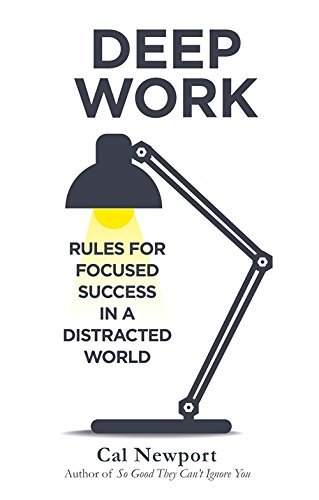
A Book Summary of “Deep Work”
Cal Newport’s “Deep Work” explains the idea of focused(deep) work and rules or strategies for the same. The book is divided into just 2 parts along with an introduction.
Introduction
In the introduction, the author gives examples to set up the background and intention of writing this book. Explain the quick meaning of deep work and the benefits associated with it. In this section, the examples are mainly around people who did great with the concept of deep work. The word “Deep Work” was actually coined by the author to give a name to this approach.
Part 1: The Idea
The first part of the book explains the actual idea of deep work and what exactly it is. This part consists of 3 main chapters.
Chapter 1: Deep Work Is Valuable
In this chapter, all knowledge workers are divided into three categories:
- The High-Skilled Workers: Those with an oracular ability to work with and tease valuable results out of increasingly complex machines.
- The Superstars: As the market is global, anyone can hire anyone remotely. The people with the skill to deliver the project will always be in demand, and that’s why these people are superstars.
- The Owners: People with capital to invest in new technology. As the development and iteration of ideas is faster now, the owners will thrive in today’s market.
After this, the chapter goes into the discussion of core abilities to thrive in the new economy:
- The ability to quickly master hard things
- The ability to produce at an elite level, in terms of both quality and speed.
Now the author explains the role of Deep Work in both the abilities mentioned above.
At the end of the first chapter, the author also touched base on the exceptions where the Deep Work might not be the one that makes sense and provided a few examples where the role itself demands the work that keeps people distracted.
Chapter 2: Deep Work Is Rare
The chapter opens with the example of Facebook’s open office policy, where people are sitting out in a huge office floor, and are easily accessible to make collaboration easy. Later, the book goes through some of the big trends in business.
The main topics discussed in the second chapter are why Deep Work is rare and involves:
- The Metric Black Hole: This explains the impact of shallow work like email checking, easy accessibility on deep work and why it’s very difficult to track and see the impact clearly.
- The Principle of Least Resistance: In the absence of clear feedback on the impact of various behaviours (mainly shallow work) on the bottom line, we tend to choose the behaviours that seem easy in the moment.
- Busyness as a proxy for productivity: The industrial indicator of productivity is doing lots of stuff in a visible manner. In the absence of a clear indicator of productivity, we tend to go towards the above behaviours. Which is again shallow work in opposition to Deep Work.
- The Cult of the Internet: The term technopoly is explained here as the mindset of taking something good if it’s hi-tech, without discussing the advantages and disadvantages of the new tech. In today’s era, internet presence is very important, and due to that, everyone is trying to be on the internet. This mindset is actually making it difficult to do deep work. To actually do deep work, it often requires a rejection of much of what is new and high-tech.
Deep Work is hard and shallow work is easy. So in the absence of a clear goal in a business climate, people tend to choose shallow work so as to look productive by doing a lot of visible work that is easy and shallow.
However, as of the current state of work, Deep Work is rare, but that does not take away its importance and impact. Even if it’s difficult, if you go deep into your work, you will be able to reap great rewards.
Chapter 3: Deep Work Is Meaningful
The chapter starts with an example of a blacksmith named Ric Furrer who specializes in ancient and medieval metalwork. He works long hours to forge a sword. The section explains the tricky work that needs absolute focus to craft something like that. What drives Ric Furrer is challenging work and the attention required to forge the sword.
There are 3 arguments provided in favour of Deep Work:
- A Neurological Argument for Depth: In the work (mainly knowledge work), to increase the time in a state of depth is to leverage the complex machinery of the human brain in a way that, for several different neurological reasons, maximizes the meaning and satisfaction you associate with your working life.
- A Psychological Argument for Depth: This explains the flow state of mind, which usually comes in the state of deep involvement, where the mind is stretched to its limits. It gives happiness when you go into the flow state, and it’s psychologically fulfilling.
- A Philosophical Argument for Depth: Cultivating craftsmanship is necessarily a deep work and requires a commitment to work deeply. Deep work is a key to extracting meaning from your profession. Deep work is about how committed you are to your work and how involved you are with it.
Part 2: The Rules
The second section of the book author provides 4 rules to achieve Deep Work. This sections mainly start with providing practical guidance on how to achieve the state of deep work. These are mainly some guidelines so that we can experiment with them.
Rule 1: Work Deeply
This section explains how to translate the idea of deep work into practice. The author argues that deep work does not happen accidentally; you need to really put effort into achieving the state of deep work. This chapter introduces four philosophies for that matter. The author explains different rituals and routines that can help achieve the state of deep work.
- Monastic Philosophy: Eliminates or radically minimises shallow obligations to maximise uninterrupted deep work for long periods.
- Bimodal Philosophy: Divides time into clearly defined stretches of deep work and shallow work, often separating them by days or weeks.
- Rhythmic Philosophy: Turns deep work into a daily habit by scheduling it consistently, making focus automatic through routine.
- Journalistic Philosophy: Fits deep work into any available time by switching quickly into deep focus, requiring high discipline and skill.
Rule 2: Embrace Boredom
This rule explains that deep work depends on training attention, not just avoiding distractions. Authors argue that constant stimulation weakens our ability to concentrate. By immediately filling every idle moment with phones or social media, we condition our brains to avoid depth. This section provides a few rules(or I would say guidelines) for embracing boredom.
- The Importance of Boredom: Deep work requires the ability to stay focused without constant stimulation, so boredom must be practised rather than avoided.
- Schedule Distractions, Not Focus: Instead of working around distractions, Newport suggests allowing distractions only at predefined times.
- Train Focus Like a Muscle: Concentration improves with deliberate practice, just like physical strength.
- Avoid Attention Residue: Switching tasks leaves mental residue that reduces the quality and depth of subsequent work.
Rule 3: Quit Social Media
This rule mainly defines the effects of social media on focus span and deep work. The author suggests some points to explain the psychology and mindset of how social media takes away your attention. And later explains the important points around how to achieve the state of deep work.
- The Any-Benefit Mindset: Most people adopt social media if it offers any benefit, even when the overall cost to focus and productivity is high. It’s a short-term benefit of using social media, but in the long term, it’s problematic.
- The Craftsman Approach to Tool Selection: Tools should be evaluated based on whether they significantly support the core activities that matter most in your professional and personal life.
- Identify High-Value Activities: Clearly defining what activities create the most value helps determine which tools are truly worth using.
- Selective Tool Use: The author argues for intentionally choosing a small number of tools that strongly support goals, while rejecting the rest.
- Attention as a Finite Resource: Social media fragments attention, making sustained deep work harder even when usage seems harmless.
Rule 4: Drain the Shallows
This chapter mainly talks about the idea of removing small, non-important items to focus on deep and important work.
- Shallow Work vs Deep Work: Shallow work consists of low-value, logistical tasks that do not require intense concentration. Deep work, on the other hand, is the opposite of shallow work.
- Schedule Every Minute of Your Day: Planning time intentionally helps reduce shallow work and protect deep work blocks.
- Quantify the Depth of Activities: Evaluating tasks by how much value they create makes it easier to prioritize deep work.
- Limit Shallow Work: Newport suggests placing strict caps on shallow activities to prevent them from consuming productive time.
- The 4DX Framework: Focusing on wildly important goals and tracking lead measures helps ensure deep work drives real results.