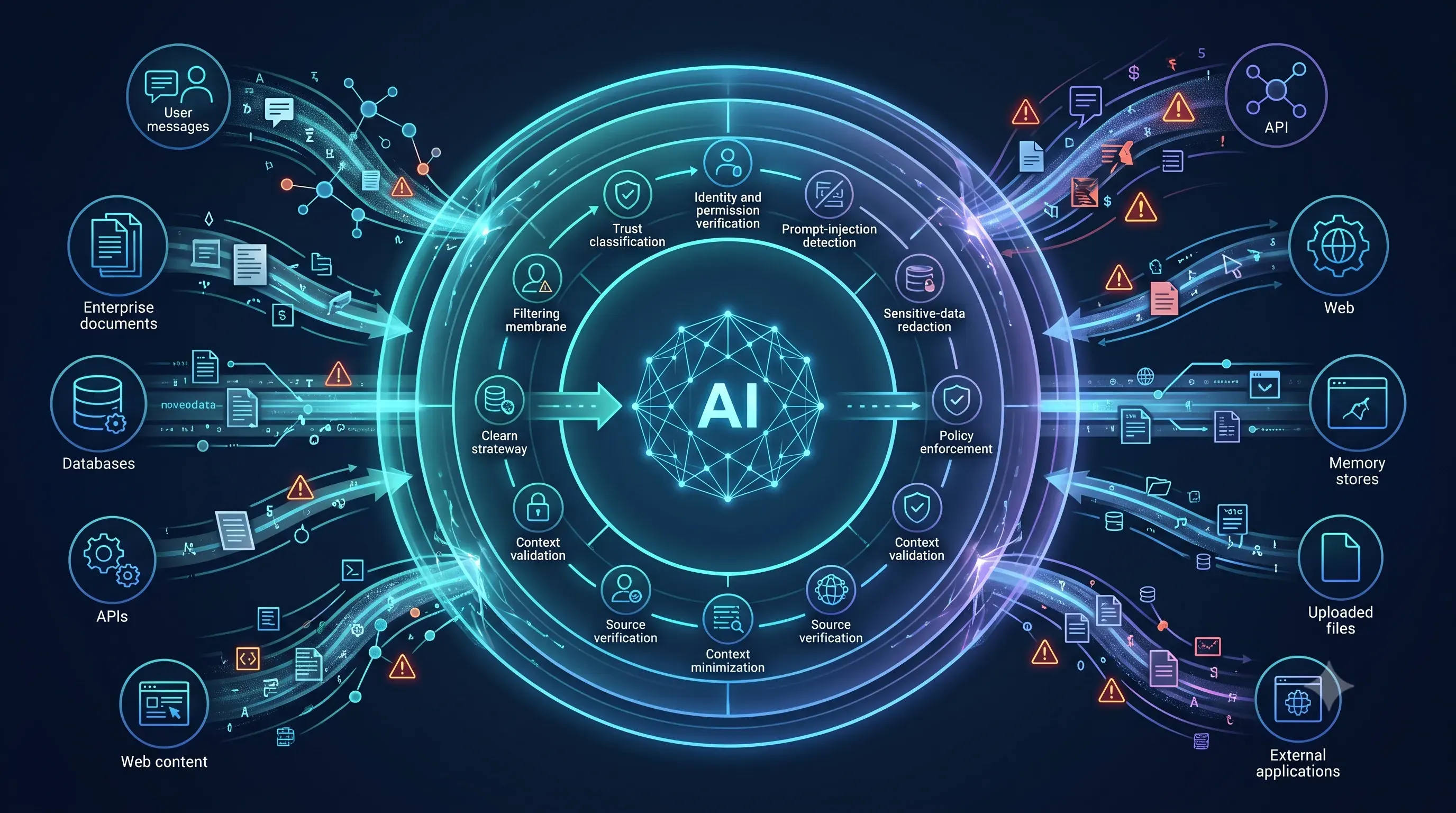
Context Firewalls - Keeping Your AI Agents in the Smart Zone
Table of contents
Open Table of contents
TL;DR
Even a well-built harness fails if you flood the agent’s context window with noise. Protect that window with Context Firewalls.
- Problem: As context grows, LLM performance degrades (“context rot”), and agents slip from the “smart zone” into the “dumb zone”
- Insight: The most precious resource for coding agents isn’t compute—it’s the context window
- Solution: Use sub-agents as context firewalls so messy exploration never pollutes the main orchestrator
- Practices: Swallow success logs (backpressure), and run frequent intentional compaction via Research → Plan → Implement
Introduction
This is the second article in my Harness Engineering series. In the previous post, we talked about building the “chassis” and the “rubber band” to govern non-deterministic AI models. But even the best-engineered harness will fail if you overwhelm the engine with too much noise.
When working with coding agents on complex, real-world problems, the most precious resource you have isn’t compute—it’s the agent’s context window. To build reliable autonomous systems, you must protect this resource by implementing Context Firewalls.
The Threat of “Context Rot” and the “Dumb Zone”
It’s a common misconception that simply giving an agent a massive context window solves all memory problems. The reality is that as context length increases, LLM performance degrades.
Researchers at Chroma refer to this phenomenon as “context rot”. When you force a model to find a needle in a massive haystack of tokens, its ability to accurately recall information and reason over long ranges decreases. Expanding the context window doesn’t make the model better at finding the needle; it often just makes the haystack bigger.
For example, every time an agent runs a massive grep search, spits out 200 lines of passing test logs, or reads an irrelevant file, it consumes its “instruction budget”. Waste enough tokens, and your agent slips out of the ~75k-token “smart zone” and deep into the “dumb zone,” where it loses coherency and starts spinning in endless loops.
The Solution: Sub-Agents as Context Firewalls
A popular but flawed trend in AI engineering is using sub-agents for roleplay—creating a “frontend engineer” sub-agent to talk to a “backend engineer” sub-agent. In practice, this anthropomorphism doesn’t work well. This can work in some cases, but the concept of context firewall is different in the context of Harness Engineering.
Instead, sub-agents should be used for context control. They function as a “context firewall” that insulates your main orchestrator agent from the chaotic noise of intermediate work.
When your main agent needs to explore a codebase or trace a bug, it shouldn’t execute those verbose searches in its own context window. Instead, it delegates the task to a sub-agent. The sub-agent gets a fresh, isolated context window to do the messy work of exploring files, reading logs, and making mistakes. Once finished, the sub-agent returns only a highly condensed summary—complete with specific file paths and line numbers—to the parent agent.
Because none of the intermediate noise accumulates in the parent thread, the main agent stays firmly in the smart zone, allowing you to maintain coherency across many sessions.
Two Tactics for Context-Efficient Engineering
LLMs are ultimately stateless functions; the quality of their output is entirely dependent on the quality of the inputs you provide. Beyond using sub-agents, here are two immediate ways to engineer better context:
1. Context-Efficient Backpressure
Stop feeding your models useless success logs. A common pattern in effective harnesses is to swallow all test, build, and lint outputs, replacing them with a single checkmark (✓) if the stage passes. If a test suite dumps 200 lines of “PASS” messages, your agent has just wasted 2-3% of its context window on an “all good” result that could have been conveyed in less than 10 tokens. Only dump the output to the agent if the exit code is not 0.
2. Frequent Intentional Compaction
You don’t have to wait for the context window to fill up before cleaning it out. The best workflows are designed around “frequent intentional compaction”. Break tasks down into a Research → Plan → Implement loop. After the research phase is complete, compact the findings into a single document and discard the bloated context window. Launch a fresh context for the planning phase, and then another for implementation.
Conclusion
In the era of Harness Engineering, we must stop treating the context window as a dumping ground. Every token you feed an agent diminishes its focus. By using sub-agents as context firewalls, practicing intentional compaction, and applying strict backpressure to your logs, you can keep your agents sharp, efficient, and firmly in the smart zone.
Ultimately, it’s all about high-quality signals for the agents—because the quality of what comes out is only as good as the context you put in.
What’s Next
This article focused on protecting the context window—sub-agents as firewalls, backpressure on noisy logs, and intentional compaction. Next in this series, we’ll keep digging into practical Harness Engineering patterns you can apply in real agent workflows.
Stay tuned.
References
- Context Rot: How Increasing Input Tokens Impacts LLM Performance — Chroma Technical Report
- Advanced Context Engineering for Coding Agents — HumanLayer
- No Vibes Allowed: Solving Hard Problems in Complex Codebases — Dex Horthy, AI Engineer