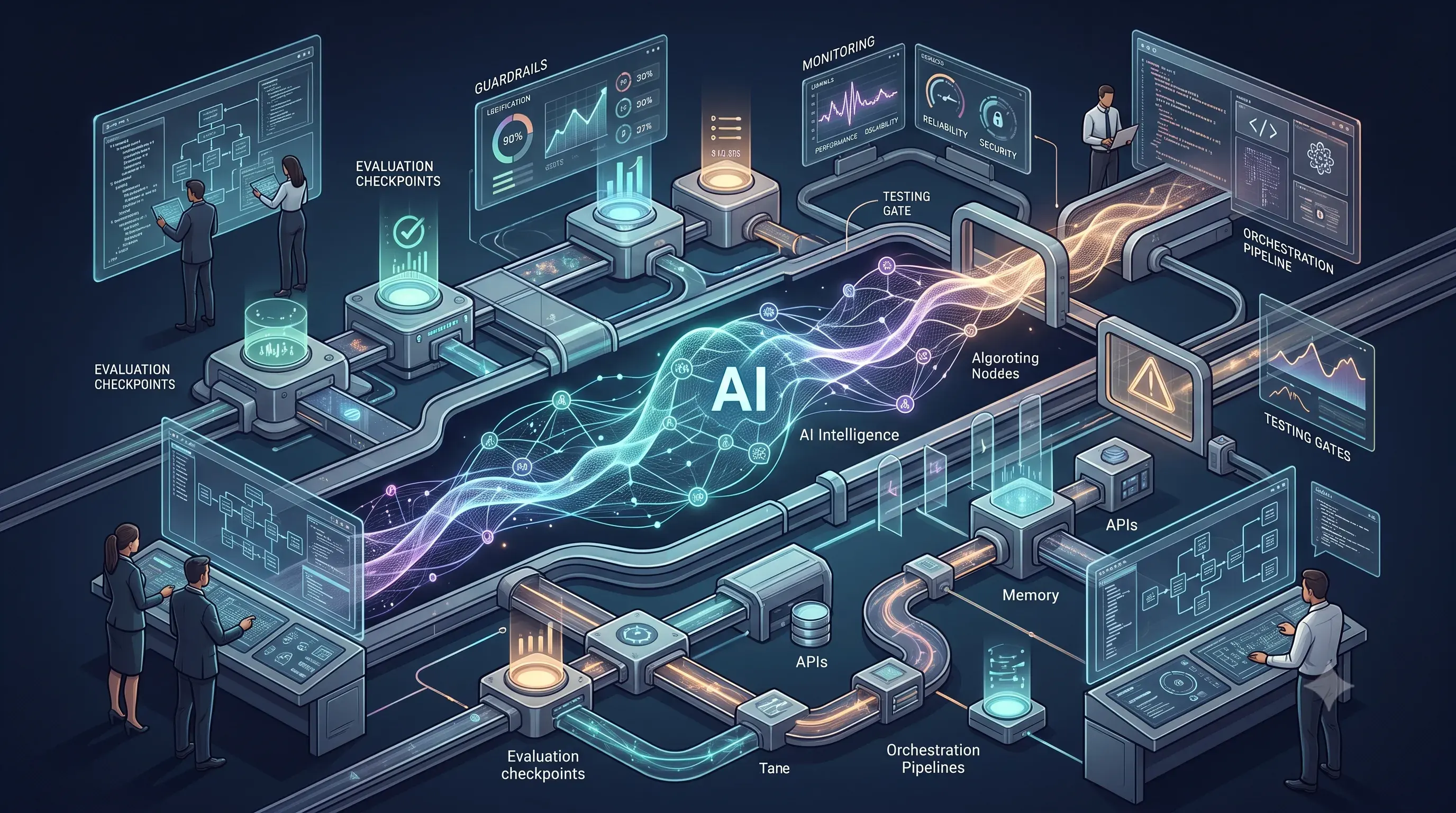
Harness Engineering - From Vibe Coding to Autonomous Reliability
Table of contents
Open Table of contents
TL;DR
If you want to build autonomous AI systems that function reliably in production, the model alone is not enough. You need a harness - the software system that wraps around the model and governs how it acts.
- Problem: AI agents skip steps, break tests, get stuck in “doom loops”, or declare victory before the code actually works
- Insight: The model is smart; it’s the environment around it that makes it reliable
- Solution: Harness Engineering - designing the constraints, feedback loops, and execution controls around the model
- Evidence: Harness-level changes alone can produce gains comparable to generational model upgrades
- Practices: Enforce verification before “done”, use sub-agents as context firewalls, and make the repository the system of record
Introduction
This is the first article in my Harness Engineering series. Here we’ll cover the foundations - what a harness is, why it matters more than waiting for the next model upgrade, and a few practices you can apply right away.
We’ve all experienced the magic of interacting with a frontier AI model. You give it a complex problem, and it immediately starts reasoning, writing code, and seemingly solving the issue. But then, something goes wrong. It skips a step, breaks a test, gets stuck in a “doom loop” of identical mistakes, or confidently declares victory before the code actually works.
Too often, we blame the model for these failures. But the reality is that the model is smart; it’s the environment around it that makes it reliable.
If you want to build autonomous AI systems that function reliably in production, you need to understand the shift from “vibe coding” to Harness Engineering.
The Engine, The Chassis, and The Rubber Band
To understand what a harness is, it helps to use a mechanical metaphor. As one AI practitioner perfectly described it: “the harness is the chassis; the model is the engine”.
An LLM by itself is just raw horsepower. It takes inputs and predicts text. Out of the box, it cannot maintain durable state across sessions, safely execute code, or autonomously recover from errors. To turn that engine into a functioning car, you need a chassis - the wiring, the steering wheel, and the brakes.
You can also think of the harness as a rubber band. You want to stretch the rubber band to give the AI agent the autonomy and flexibility to explore solutions, navigate the web, or rewrite files. However, the moment the agent begins to hallucinate, overreach its scope, or stray from your architectural standards, the tension of the rubber band (the harness) snaps it back into a controlled, deterministic boundary.
The Evolution: How We Got Here
The evolution of AI development over the past few years can be broken down into three distinct eras:
- Prompt Engineering (2022–2024): The focus was purely on the text. What instructions can we give the model to get better outputs?
- Context Engineering (2025): The focus shifted to information management. What structured information (like RAG and memory) should we assemble and present to the model?
- Harness Engineering (2026): The focus is now on systemic governance. What constraints, feedback loops, and execution controls must we design to make the agent reliable?
The Anatomy of an Agent Harness
Formally, a production-grade agent harness is defined as a software system that implements six core governance functions:
- Execution Loop (E): Manages the “observe-think-act” cycle, deciding when to sequence tasks, when to terminate, and how to recover from errors.
- Tool Registry (T): Maintains a validated catalog of tools the agent can use to affect the outside world.
- Context Manager (C): Governs the information entering the context window to prevent “context blowout” and attention dilution.
- State Store (S): Persists task-relevant state across turns and sessions so the agent doesn’t forget its overall goal.
- Lifecycle Hooks (L): Intercepts actions before and after they happen to enforce authentication, logging, and security policies.
- Evaluation Interface (V): Instruments the execution to capture action trajectories and goal-completion signals for offline analysis.
When these six components work together, they stop the agent from acting like an unpredictable intern and turn it into a relentless, self-correcting machine.
Why Harness Engineering is the Highest Leverage Skill in AI
It’s tempting to wait for the “next big model update” to fix your agent’s unreliability. But empirical evidence shows that harness-level changes alone can produce gains comparable to generational model upgrades.
In one study, simply optimizing an agent’s harness without modifying the underlying model improved its performance on TerminalBench by 26%. In another case, xAI’s Grok Code Fast 1 jumped from a 6.7% success rate to 68.3% on SWE-bench simply by changing the edit-tool format in the harness.
3 Best Practices for Harness Engineering
If you are building coding agents or AI workflows today, here is how you can implement Harness Engineering immediately:
1. Don’t Run on Vibes (“No Verdict, Not Done”)
Agents will often declare a task finished prematurely. Your harness must enforce strict verification. Before a task is counted as “done”, a deterministic, independent check - like a test suite or a linter - must run and pass. If the exit code isn’t 0, the harness should catch the error and force the agent to try again.
2. Use Sub-Agents as “Context Firewalls”
One of the best ways to keep a coding agent in the “smart zone” is to prevent its context window from filling up with useless logs and failed attempts. Delegate research and specific tasks to sub-agents. The sub-agent does the messy work and returns a highly condensed answer to the main orchestrator agent, keeping the main loop clean and focused.
3. Make the Repository the System of Record
Provide your agents with explicit, machine-readable rules using files like CLAUDE.md or AGENTS.md. Instead of relying on a massive, bloated system prompt, use these files to give the agent progressive, structured maps of your architecture, coding conventions, and testing requirements.
Conclusion
We are moving away from the era of “vibe coding” and entering a deeply technical engineering discipline. The most successful AI teams today aren’t just building better prompts; they are building rigorous, deterministic harnesses that wrap around non-deterministic models.
Give your AI the engine to run, but don’t forget to build the chassis and the rubber band to keep it on the road.
What’s Next
This article focused on the why and the what of Harness Engineering. Next in this series, we’ll dig into Context Firewalls - how sub-agents keep the main loop clean by absorbing messy research, logs, and failed attempts so the orchestrator stays in the smart zone.
Stay tuned.